
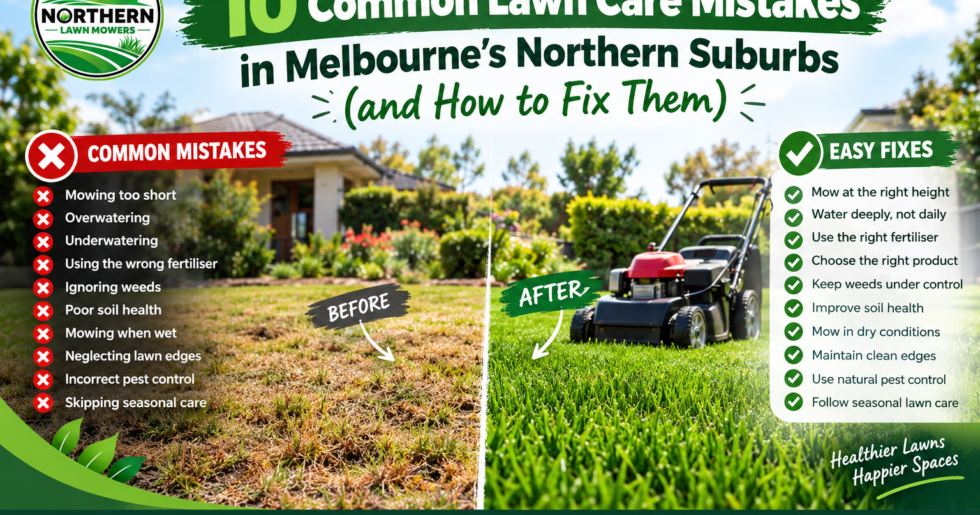
Most people want the same thing from their lawn: thick, green grass that looks good from the street and feels great underfoot. Yet plenty of lawns across Melbourne’s north end up patchy, weedy or burnt brown by January, even when the owner is putting in real effort.
The problem is rarely a lack of effort. More often, it is a handful of small, well-meaning mistakes that add up over time. Cutting too short, watering too lightly, ignoring the soil or mowing on the wrong schedule can all quietly weaken a lawn.
The good news is that these mistakes are easy to fix once you know what to look for. In this guide, we walk through the 10 most common lawn care errors we see in Melbourne Northern Suburbs, explain why they cause problems in our local conditions and show you what to do instead.
Why Local Conditions Make Lawn Care Trickier
Lawn advice found online is often written for a generic climate. Melbourne’s northern suburbs have their own quirks:
- Heavy clay soils that compact easily, drain slowly in winter and crack in summer
- Hot, dry summers with strong northerly winds that dry grass quickly
- Cool, damp winters that encourage moss and winter weeds
- A mix of lot sizes, from small new-estate yards to large rural-residential blocks
A routine that works in a coastal suburb with sandy soil may not suit a clay block in Craigieburn or Epping. With that in mind, here are the mistakes to avoid.
Mistake 1: Mowing Too Short
It is tempting to cut the lawn as short as possible so it lasts longer between mows. Unfortunately, this is one of the fastest ways to damage grass. Scalping exposes soil, stresses the plant, reduces its ability to photosynthesise and gives weeds room to move in.
The fix: Follow the one-third rule. Never remove more than a third of the leaf blade in a single mow. For most home lawns, a height of roughly 30 to 50 mm works well, and a touch higher in summer helps shade the roots and hold moisture.
If you would rather skip the guesswork, a regular lawn mowing service keeps your grass at the right height all year.
Mistake 2: Mowing With Blunt Blades
A dull blade does not slice grass. It tears it. The result is ragged, frayed tips that turn brown, lose moisture and are more vulnerable to disease. If your lawn looks slightly grey or whitish a day or two after mowing, blunt blades are a likely culprit.
The fix: Sharpen or replace your mower blade at least once per season, and more often if you mow frequently or hit hard objects such as stones and tree roots.
Mistake 3: Watering Little and Often
A quick sprinkle every evening feels like good care, but it encourages shallow roots. Grass with shallow roots dries out quickly in a heatwave and struggles to recover.
The fix: Water deeply and less often. A good soak once or twice a week lets moisture reach deeper into the soil and trains roots to grow down. Water early in the morning to reduce evaporation, and always follow current Victorian water restrictions and any local rules.
A simple test: after watering, push a screwdriver into the soil. If it slides in easily to around 10 cm, you have watered enough.
Mistake 4: Ignoring Compacted Clay Soil
Many northern suburbs sit on clay-based soil that packs down tightly, especially in high-traffic areas. Compacted soil blocks water, air and nutrients, which means your grass struggles no matter how much you water or feed it.
The fix: Aerate once a year, ideally in autumn or spring when the lawn is actively growing. You can use a garden fork for small areas or hire a core aerator for larger ones. Topdressing with a good quality sandy loam after aerating can also improve drainage over time.
Mistake 5: Skipping Fertiliser (or Overdoing It)
Lawns are hungry. Without regular feeding, grass thins out, loses colour and becomes an easy target for weeds. On the other hand, too much fertiliser, or applying it in extreme heat, can burn the lawn and cause a flush of growth you then have to mow constantly.
The fix: Use a slow-release fertiliser suited to your grass type, typically in early spring and again in autumn. Always follow the label rate and avoid applying just before heavy rain or during a heatwave.
Mistake 6: Letting Weeds Go to Seed
A few weeds can seem harmless, but one flowering plant can drop thousands of seeds. Before long, the lawn is covered in bindii, onion weed, clover or winter grass.
The fix: Act early. Remove weeds before they flower, keep the lawn dense and treat larger outbreaks promptly. Not sure what you are dealing with? Our guide to common lawn weeds in Australia helps you identify and treat the most common culprits.
For stubborn infestations, a professional weed spray service can target broadleaf weeds without harming your lawn when applied correctly.
Mistake 7: Mowing Wet Grass
Mowing after rain might feel like a good use of a dry window, but wet grass clumps, clogs the mower and cuts unevenly. It can also leave ruts in soft ground and spread disease between areas of the lawn.
The fix: Wait until the grass surface is dry. Late morning or early afternoon is often ideal, once the dew has gone. If the grass is very long and wet, raise the cutting height for the first pass and lower it slightly on the second.
Mistake 8: Using the Same Mowing Pattern Every Time
Mowing in identical lines week after week creates ruts and encourages grass to lean in one direction. Over time, this leads to uneven wear and a flattened look.
The fix: Change direction each time you mow. Alternate between stripes, diagonals and cross-hatching. It is a small change that improves appearance and helps the grass stand upright.
Mistake 9: Leaving It Too Long Between Mows
In spring, grass can double its growth in a fortnight. If you miss a couple of mows, you may end up needing to cut far more than the one-third rule allows, which shocks the lawn and leaves heavy clumps of clippings.
The fix: Mow regularly through the growing season, then ease off in winter. As a rough guide:
- Spring: every 7 to 14 days
- Summer: every 14 to 21 days, depending on rainfall and grass type
- Autumn: every 14 to 21 days
- Winter: about every 4 to 6 weeks
If life gets busy, a scheduled service means your lawn is never left to run wild. You can get a lawn mowing quote to set up a fortnightly or monthly plan.
Mistake 10: Not Matching Care to Your Grass Type
Lawn types behave very differently. Couch and kikuyu are warm-season grasses that grow vigorously in summer and slow down in winter. Fescue and ryegrass are cool-season varieties that stay greener through cooler months but can struggle in heat. Buffalo grass is popular for its soft leaves and shade tolerance.
Treating them all the same leads to problems. Kikuyu, for example, can become thatchy and invasive if left unchecked, while fescue may need more water during hot spells.
The fix: Identify your grass type, then adjust mowing height, watering and feeding accordingly. If you are unsure what you have, a quick photo and a conversation with a local lawn professional will usually settle it.
Quick Reference: Do This, Not That
- Mowing height: Do keep it around 30 to 50 mm. Don’t scalp the lawn.
- Blades: Do sharpen them each season. Don’t let them go dull.
- Watering: Do soak deeply once or twice a week. Don’t sprinkle daily.
- Soil: Do aerate compacted clay yearly. Don’t ignore hard, bare patches.
- Fertiliser: Do feed in spring and autumn. Don’t apply in extreme heat.
- Weeds: Do remove them before seeding. Don’t wait until the lawn is overrun.
- Timing: Do mow when the grass is dry. Don’t mow soaking wet turf.
- Pattern: Do change direction. Don’t repeat the same lines.
Bonus: Seasonal Lawn Care Calendar
If you prefer a simple plan, this calendar works well for most lawns in the north:
Spring (September to November): Fertilise, begin regular mowing, treat weeds and overseed any thin patches.
Summer (December to February): Raise the mowing height, water deeply, avoid heavy foot traffic on stressed grass and keep clippings short.
Autumn (March to May): Aerate, overseed, apply autumn fertiliser and clear fallen leaves.
Winter (June to August): Mow less often, keep off frosty or soggy turf and plan any improvements for spring.
DIY or Hire a Professional?
Plenty of people enjoy looking after their own lawn, and there is nothing wrong with that. But there are good reasons to bring in help:
- Time: Regular mowing, edging and cleaning up takes hours every fortnight.
- Equipment: A good mower, whipper snipper, edger and blower represent a real investment, plus storage and servicing.
- Large or sloping blocks: Bigger or tricky properties need specialist machinery and experience.
- Health and mobility: Some people simply cannot safely do the physical work.
- Consistency: Professionals work to a schedule, so your lawn never gets away from you.
The cost is often lower than people expect. Our lawn mowing cost guide for 2026 explains what affects pricing so you can budget with confidence.
Local Lawn Mowing Across the North
Our crews work across the region, including Epping, Craigieburn, Sunbury, South Morang, Mill Park, Reservoir, Thomastown, Broadmeadows, Wollert, Donnybrook and surrounding suburbs. You can check whether we cover your area on our service areas page.
Lawn Care FAQs: Melbourne Northern Suburbs
What is the best height to mow my lawn?
For most home lawns, around 30 to 50 mm works well. Go slightly higher in summer to protect roots and retain moisture, and never remove more than one-third of the blade at once.
How often should I water my lawn?
Water deeply once or twice a week rather than lightly every day. The exact amount depends on weather, soil and grass type. Always follow current water restrictions.
Why is my lawn full of weeds?
Weeds usually take over when grass is thin, mowed too short, under-fed or stressed by drought and compacted soil. Improving lawn density and treating weeds early are the best long-term solutions.
Why does my lawn have brown patches?
Common causes include drought stress, scalping, pet urine, fungal disease, compacted soil and insect damage. Identify the pattern, such as round patches, uniform browning or isolated spots, and adjust your care accordingly.
Should I bag or leave the clippings?
Short clippings can be left on the lawn, where they break down and return nutrients. If the grass is long, wet or weedy, bag or remove the clippings to avoid smothering the lawn or spreading seeds.
When is the best time to mow?
Mid-morning to early afternoon, once the grass is dry, is usually best. Avoid mowing during extreme heat or when the lawn is wet.
How much does lawn mowing cost in Melbourne Northern Suburbs?
Price depends on lawn size, access, grass condition and how often you book. The easiest way to get an accurate figure is to request a quote for your property.
Can NDIS funding cover lawn mowing?
In some cases, yes, if the service is reasonable and necessary because of a participant’s disability and is allowed in their plan. Check with your plan manager or support coordinator first.
Have a different question? Browse our full FAQ page or contact our team.
Final Thoughts
A great lawn is rarely about doing more. It is about doing the right things at the right time and avoiding the small mistakes that quietly hold grass back. Mow at the correct height, keep blades sharp, water deeply, look after your soil and tackle weeds early, and your lawn will reward you all year.
If you would rather leave it to the experts, we are here to help. Get a Lawn Mowing Quote today and enjoy a better-looking lawn without the weekend work.